

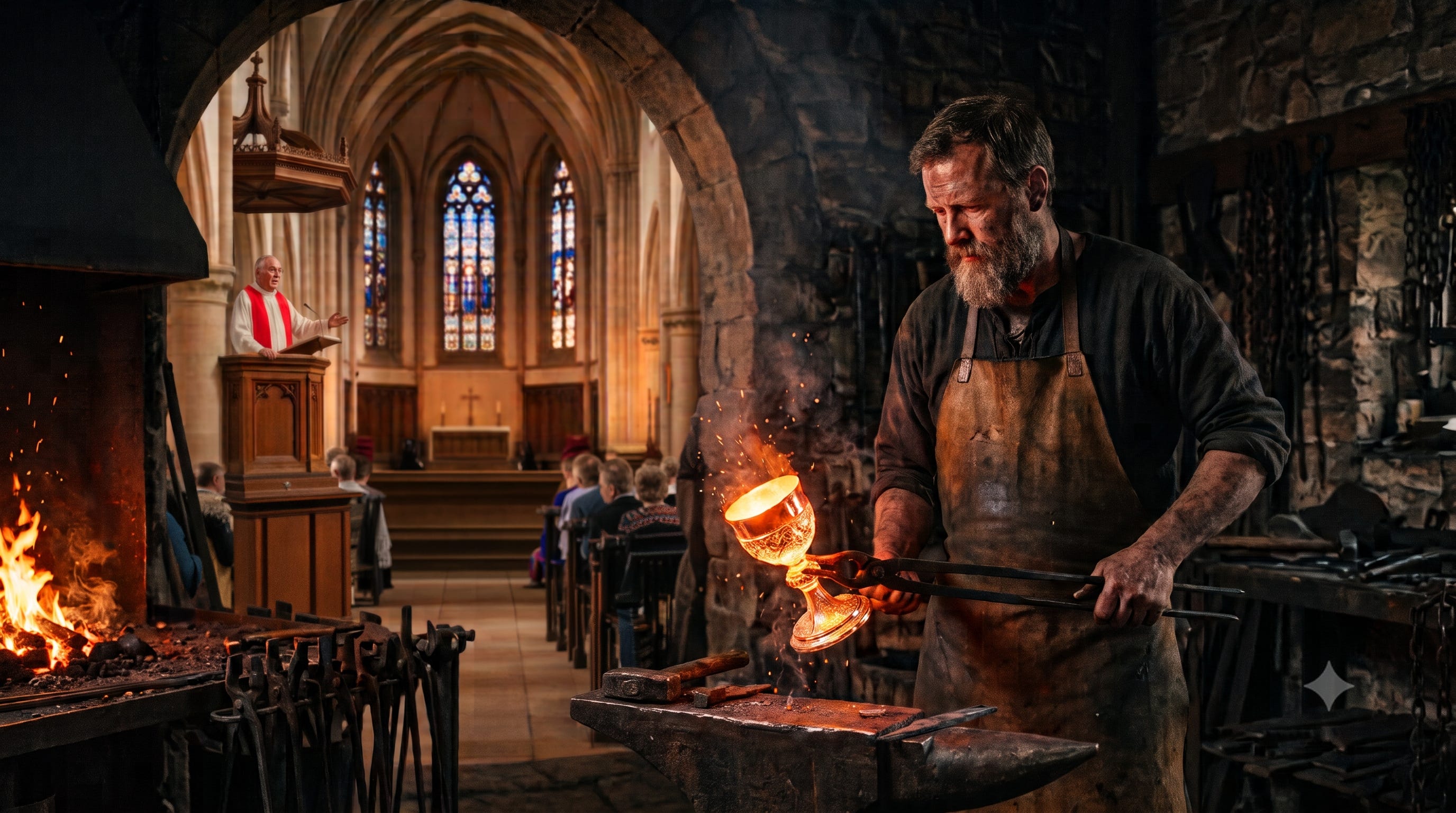
Before he wore the miter, Dunstan worked a forge.
The tenth-century Archbishop of Canterbury spent his early years as a working artisan: a silversmith crafting church plate, a scribe, an illuminator of manuscripts, a musician. To this day he remains the patron saint of goldsmiths, blacksmiths, and locksmiths. He was a man who knew the weight of a hammer and the discipline of a craft, and who of necessity worked with the best and latest tools of his age. If Dunstan had lived in first-century Galilee, there is a Greek word that would have described him precisely: τέκτων. A craftsman. A builder. The same word the Gospels use for Jesus and for Joseph.
So it caught my attention when, in May 2026, an Episcopal priest in Massachusetts published a pledge in Dunstan’s name...on his feast day, no less. The Saint Dunstan Pledge for Preachers is a public vow to keep generative AI out of sermon preparation entirely, at every stage, from the first brainstorm to the final draft. Around 150 preachers signed within its first weeks, and the conversation it started has been spreading through clergy circles ever since.
Hold that picture for a moment: the newest tool in human history has provoked a vow of total abstinence, sworn in the name of a saint who worked with tools for a living.
There is something worth examining in that tension. But before we examine it, the pledge deserves what any sincere conviction deserves: a fair hearing.
What the Pledge Actually Says
The pledge, written by the Rev. Emily García, is admirably specific. Signers commit that at no point in the brainstorming, planning, drafting, or writing of their sermons will they use ChatGPT, Claude, Copilot, Gemini, or any other generative AI available to them. They vow to use their own words, to quote only words written or spoken by people, and to find, evaluate, and cite their own sources. The grounding is vocational: preaching the Gospel is a task the signer has been entrusted with, and it requires their effort, their prayers, and whatever skill they may have. The pledge even includes thoughtful carve-outs for assistive technology...voice memo transcription, text-to-speech, spelling and grammar suggestions, ordinary search.
And the pledge did not arrive in a vacuum. Within a span of about eighteen days, Pope Leo XIV promulgated his first encyclical, Magnifica Humanitas, on safeguarding the human person in the age of AI, and the Archbishop of Canterbury addressed the human impact of AI before the House of Lords. Earlier in the year, the Pope had urged priests of the Diocese of Rome to resist the temptation to prepare homilies with AI, because a true homily is an act of shared faith, and AI “will never be able to share faith” (see the full story about Pope Leo’s comments here). Whatever else this movement is, it is not fringe anxiety.
Here is the context that makes it matter. According to Barna’s research with Gloo, only 13 percent of U.S. Protestant pastors say they avoid AI entirely, and nearly a quarter now write or edit sermons with its help. Yet 79 percent worry about AI beginning to act as a replacement for God, and the single most common emotion pastors report toward the technology is caution.
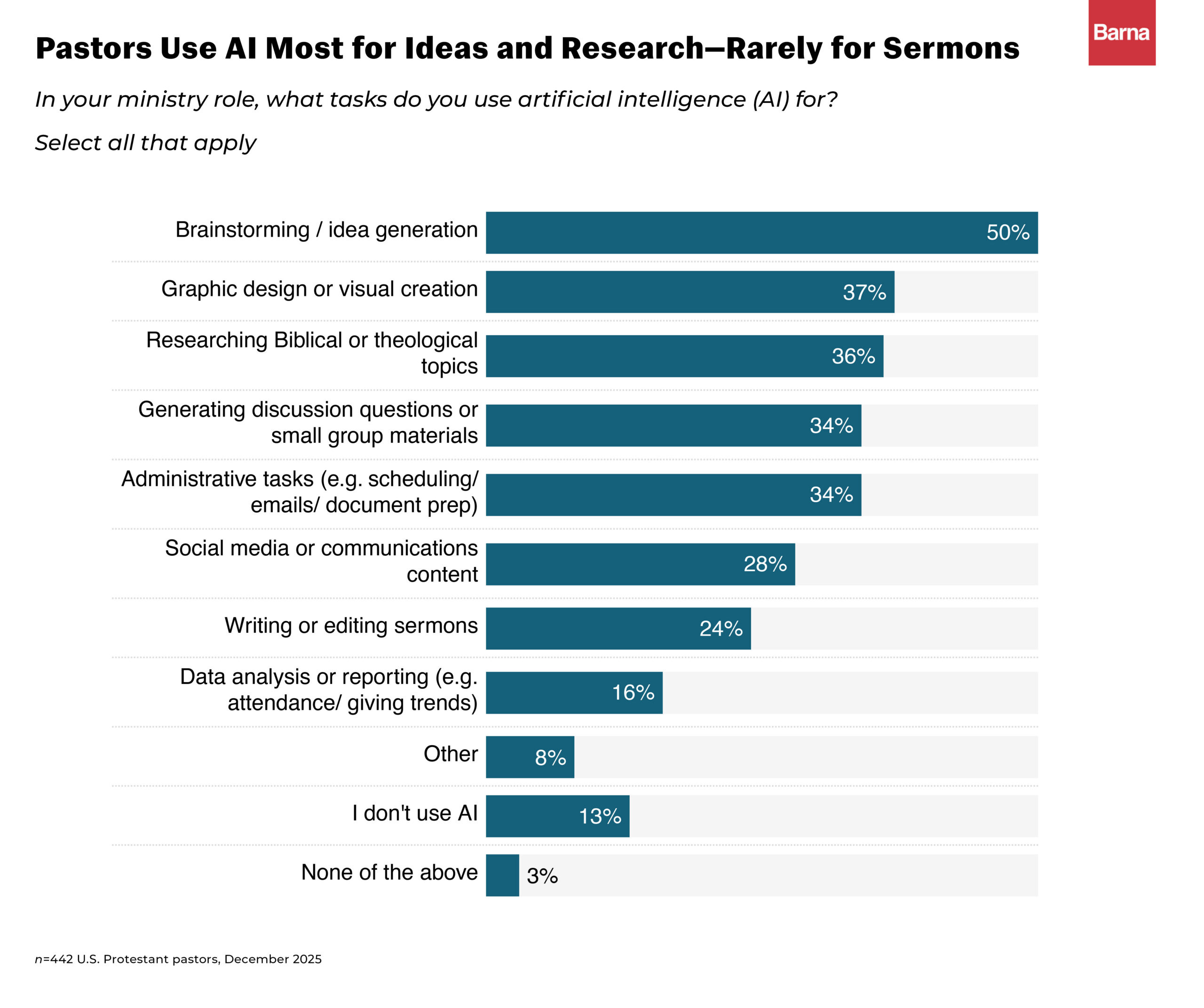
Read those numbers together and you should be able to see it clearly: the pledge signers are a minority in behavior, but they speak for a majority in collective concern. They are saying out loud what most pastors feel and have not yet resolved. That alone earns them a serious answer rather than a dismissive one.
Taking the Resistance Seriously
The strongest versions of the resistance case are not naive, and they deserve to be stated at full strength.
The first is sacramental. The Rev. Dr. Ruthanna Hooke, who teaches homiletics at Virginia Theological Seminary, opposes generative AI in preaching because preaching is an incarnational event: the Holy Spirit working with and through our full humanity to speak God’s Word. On her account, God desires us to bring the whole of ourselves to the wrestling with Scripture, and words sourced from something non-human undermine that process at its root.
The second is communal. Bird Treacy, a licensed preacher who signed the pledge, argues that sermon preparation was never meant to be a solitary transaction between a preacher and a text, let alone a preacher and a machine. Christian life is formed in community, and the efficiency case for AI is really a case for sidestepping the conversations... with colleagues, with parishioners, with fellow believers... that preaching is supposed to grow from.
The third runs deepest: formation. The struggle with the text on Tuesday is part of what the congregation receives on Sunday, because the wrestling forms the preacher. Pope Leo made the point with a metaphor any athlete understands: like the muscles of the body, the mind and its capacities die if we do not use them. A preacher who never wrestles slowly loses the strength to wrestle.
You can view longer articulations of each of their comments in an article by Caleb Maglaya Galaraga entitled “Preachers Pledging Not to Use AI for Sermons.”
Let me say plainly what I have said elsewhere: these are not foolish fears. The real essentials of sermon preparation are the prayer, the wrestling, the discernment, and the Holy Spirit’s insight, and there is a legitimate concern... an actual spiritual danger... when we circumvent those. Anyone who dismisses that concern has not sat with the weight of standing before God’s people claiming to bring them a word from the Lord.
One signer’s story makes the danger concrete. Jack Franicevich spent years as a professional copywriter producing content for megachurch pastors, and he watched his employer lose clients as those same pastors discovered they could get their sermons from ChatGPT instead (see his fuller comments in Galaraga’s “Preachers Pledging…” article). Sit with that for a second, because it tells us two things at once: (1) The threat is real. And (2) the threat did not begin with AI (those pastors were already outsourcing the work to him).
That second observation is where the pledge’s argument begins to wobble.
The Oldest New Objection
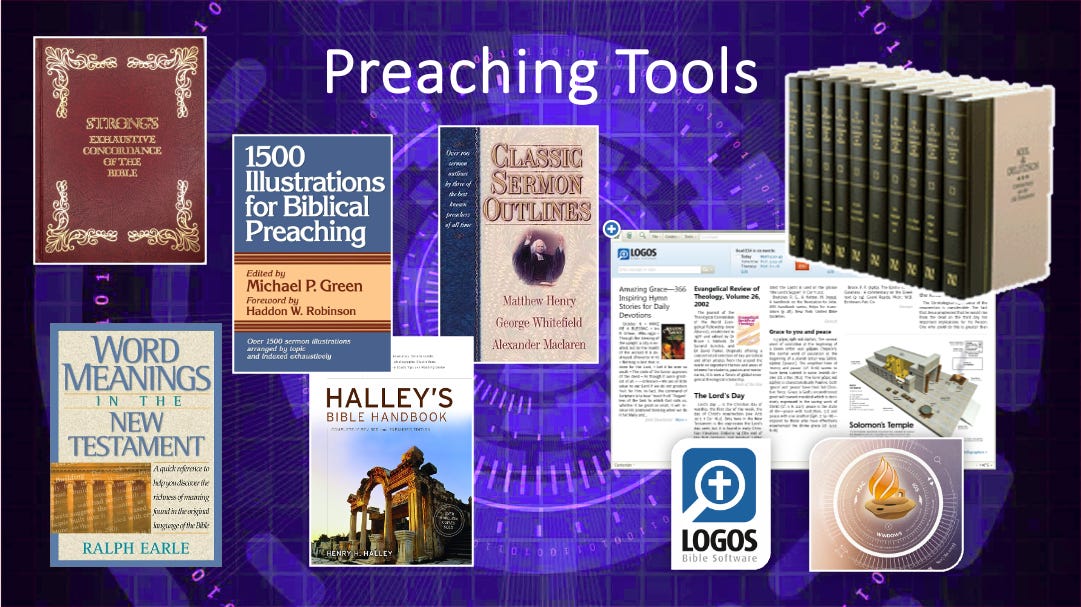
Walk through any preacher’s study and look at the shelves. Commentaries. Bible dictionaries. Concordances. Handbooks of sermon illustrations. Prepared outlines. Bible software that can do in ten seconds what once took an entire sabbatical.
Every one of those tools spares the preacher days, weeks, or even years of research tracking down obscure details from tedious exploration of the original languages and manuscript comparisons. James Strong, for example, spent decades of his life compiling his exhaustive concordance of original language meanings and stems. Now, preachers can use a reference book to quickly find relevant insights, drawing on the research of others. And precisely because of that shortcut, every one of those preaching tools was considered “cheating” when it first appeared.
The established homiletics community feared that:
The concordance was going to replace knowing your Bible.
The commentary was going to replace personal exegesis.
Bible handbooks were going to replace the preacher’s own research and study.
Sermon illustration books were going to replace personal pastoral observation.
Books of sermon outlines were going to replace Spirit-led creativity.
Bible software was going to replace original-language study.
Time has proven their worth. Each of these tools can be a shortcut, but they don’t have to be. In fact, every preacher I know uses them, and every Bible College, seminary, and ministerial preparation program I’m aware of teaches – and expects – their ministers to utilize these tools. Some of these tools have served the church for centuries. Most now see them as valuable timesavers so the preacher can focus on the wrestling, study, and sermon preparation, as well as the regular work of pastoral ministry. The issue is with HOW you use the tool, not whether you use it.
This is a pattern I have traced before here on Substack, from Gutenberg’s press to Charles Simeon’s scandalous barrel organ, and it repeats with almost mechanical reliability: resistance, suspicion, accusation of cheating, then quiet universal adoption:


But honest discernment requires the other half of the pattern too. Every one of those tools genuinely enhanced preparation, yet every one of them also carries with it an inherent temptation to bypass the requisite wrestling:
The same commentary can be a conversation partner that deepens your encounter with the text, or a substitute that replaces it.
A word study reference can enhance your congregation’s understanding of the nuance behind a specific word, or it can make you sound smart without fully understanding the implications.
A book of sermon outlines can help you fill in missing points, find better wordings, or craft memorable points, or it can be a shortcut to sounding prepared when you’re not.
A thesaurus can help you craft that perfect alliteration, or it can help you make points without listening to what the Holy Spirit actually wants to say in the moment.
A preacher can lean so hard on one commentary that the sermon becomes the commentary with a few jokes or quotes added. That’s a failure mode that Episcopal priest Peter Levenstrong names candidly in his own writing on this question.*
Most preachers have at some point repurposed old sermons when faced with a hard week or a dry spell. Most of us have used sermon outlines and sermon illustration books for ideas and inspiration; some have even purchased sermons outright, downloaded example sermons, or preached someone else’s sermon. The technology-enabled temptation to shortcut the real work of preaching is as old as the task itself; even Moses faced it: “I struggle with public speaking and don’t think I can do that, Lord…let Aaron speak for me” (Exodus 6:28-7:7).
Which means the question was never whether a preacher used a tool. The question is whether the essential, irreplaceable work of sermon preparation and formation still happened.
But Something Really Is New
If I stopped there, I would be guilty of the opposite error: pretending AI is just another concordance. It is not, and the pledge signers deserve to have the difference named precisely, because they are sensing something real…a legitimate concern.
My colleague Peter Levenstrong,* associate rector of St. Gregory’s of Nyssa Episcopal Church in San Francisco, has put his finger on it better than anyone I have read:
For as long as anyone has preached, polish has been expensive. A well-built sermon meant a human being had put in the hours, knew the text, and cared enough to make the language sing, because you simply could not fake the finish without doing the work. The polish was evidence. We learned, over centuries, to trust it as a sign of the substance underneath, and we were right to, because the link was real and reliable.
That link is what AI breaks. Polish is cheap now, and it has come loose from labor. A sermon can arrive fluent and tailored to your people and still be hollow at the center, and the fluency that used to reassure you tells you nothing anymore about whether anyone wrestled with anything.
— Peter Levenstrong in “The Sermon Was Never the Manuscript”
I see the identical crisis every day in my marketplace vocation. In higher education, the polished artifact... the essay, the research paper, the presentation... was always our evidence that learning had occurred. Grade the product, and you could trust the process behind it. Generative AI has ended that arrangement, and the educators adapting best are the ones who have realized the polished product was never the point. What we were actually cultivating all along (or at least were supposed to be) was the critical thinking, the synthesis, the struggle...the process of learning. So savvy educators are redesigning assessment around the process itself. The parallel to the pulpit is a tight fit: the manuscript was never the point. The formation of the preacher, and the word wrestled out for a particular people at a particular moment, was always the point. AI has simply forced both classroom and church to stop grading the artifact and start attending to the work.
We have also already seen what the fully outsourced version looks like. In 2023, a church in Fürth, Germany hosted a service generated almost entirely by ChatGPT, avatars and all... an experiment its own creator estimated was 98 percent machine. My friend and colleague Jon Wiest examined that service at length in an article for Exponential (an article I was glad to contribute some thinking to), and the eyewitness verdict he highlights says everything: “There was no heart and no soul.” Jon’s conclusion is one I would set beside anything the pledge affirms: to the degree that ministry leaders “depend more on technology than the Holy Spirit,” the power of their preaching is diminished.
So yes... something is genuinely new. But notice what it is. What changed is the cost of counterfeiting the work. The location of the work never moved.
The Tool Is Not the Symptom
And this is where I think the pledge, for all its sincerity, draws the line in the wrong place. The resistance mistakes the tool for the problem. It assigns culpability to an object that has no moral agency, no capability, and no character. A large language model cannot skip your prayer life. It cannot decline the wrestling on your behalf. Only a preacher can do that, and preachers were doing it for centuries before the first transformer model was trained. AI didn’t create the problem, and it isn’t causing the short-circuiting of priorities; it just made it easier for someone who hasn’t done the requisite work and wrestling to bypass what’s essential in sermon preparation. With AI you can sound polished but miss the part that matters most.
What’s disturbing - and problematic - about this, however, is that when we blame the technology for the shortcomings of humans, we abdicate our God-given discernment in favor of an easy blame game. And when we ascribe moral character (or worse, culpability) to an inanimate object...treating the tool itself as corrupt or corrupting...we are dabbling, however unintentionally, in a quiet form of idolatry. AI is a tool, not a god. Yet, too many critics and naysayers today are ascribing god-like qualities to AI, and that’s worrisome.
There is a second problem, and it is practical. The line the pledge draws cannot actually hold, because the boundary it depends on – generative AI versus everything else – dissolved years ago. It is 2026, after all. AI has been around for decades, and it is firmly woven into our daily life, whether we realize it or not: it filters our email, ranks our social media feeds, routes our navigation apps, recommends our movies & TV shows, corrects our spelling, transcribes our voice memos, creates meeting summaries, and powers the very search engines the pledge explicitly permits.
Several of the pledge’s own carve-outs run on the same underlying technology as the tools it forbids, a point the Rev. Chris Corbin...an Episcopal priest who shares the pledge’s deepest convictions and still declined to sign...has made with technical precision. A preacher cannot check the weather, drive to the hospital, or post the church potluck announcement without AI mediating the task. So although the carve-outs are well-intended, they expose the fallacy of this whole resistance effort:
Facebook’s algorithms utilize AI and machine learning heavily. So, the distribution that Rev. Emily García achieved in posting that pledge was accomplished using AI. It was AI that made it possible. And the majority of those initial signers learned about it in their feed thanks to an AI algorithm.
Searching articles online with Google, such as trying to find the Saint Dunstan pledge, looking for the Pope’s encyclical or the Archbishop’s speech, is powered by AI and machine learning. Much of it (though not all) is generative. It’s not just the “AI Overview” on Google that’s generative; the ranking and rating system, and the algorithm that powers the searches is, too.
There is no such thing as “nongenerative AI” for spelling and grammar suggestions; that’s all powered by AI and machine learning, and quite a bit of it is of the generative variety. The same goes for podcast apps and YouTube: the recommendation and referral engine they use is powered by not just AI & machine learning, but has many generative features.
Reputable Bible translation leaders like Wycliffe in recent decades have been using AI & machine learning to accelerate the process of Bible translation. In fact, that’s where my interest in AI & machine learning was first piqued…in a tour of Wycliffe’s headquarters over 30 years ago, and I’ve sat in workshops and conferences with their translators sharing the work of AI-facilitated Bible translation (it’s what is finally enabling us to make significant progress at fulfilling Christ’s command to take the gospel into the whole world).
Drawing the line at generative AI in sermon preparation, while living comfortably inside all the rest, is not a coherent theology of technology. It is a moment frozen in time, in much the same way as the Amish resistance to technology comfortably accepts tech up to a specific point and century, but not afterwards. They accept technologies like buttons and buggies, irrigation, farming, and construction, but declare newer technologies corrupting (the saints of earlier centuries would have had grave concerns about their use of wheels, buggies, and steel farming implements). They’re mistaking a lifestyle and culture preference for a well-reasoned theological choice.
Vows, Precautions, & Individual Liberty
Now, there is one version of the vow I appreciate, as it has a meaningful pastoral sense. In the Sermon on the Mount, Jesus said that if your right hand causes you to sin, it is better to cut it off than to keep it (Matt. 5:27-30). Admittedly, most would say this was obvious hyperbole to make a point, not a literal command, but the point is still clear, and the same application works for AI as well: If a preacher examines their own heart and concludes that they cannot pick up this tool of generative AI without being tempted to skip the prayer and the wrestling that’s required, then abstinence is probably the more faithful choice for them. For them, it becomes a kind of modern monastic vow, and far better a faithful vow than delivering a counterfeit or ill-conceived sermon. The pledge merely removes a tool; it doesn’t address the requisite discipline. It’s a modern example of what Paul talked about in 1 Corinthians 8 & 9 about individual liberty, about how some may find such practices objectionable while others don’t.
But a vow that safeguards one person’s weakness is not a standard for the whole church, and for me and most of the ministers I know, universalizing it would be an overreaction whose logic does not bear out, and for most people it would not achieve its intended aim. The preacher determined to phone it in never needed AI to do so. I personally know dozens of ministers who use generative AI regularly (including in sermon preparation) who never let the convenience take away from their prayer, wrestling, and letting the Holy Spirit guide their development. For the ones I know best, I think it has made them better preachers who can communicate clearly and effectively. And if God was willing to overcome Moses’ limitations by having Aaron speak for him, I think He’s perfectly fine with responsible use of AI, too.
Corbin lands where I land, from inside a different tradition entirely: the real line is not between technologies but between tasks. Some work must be done by a human being before God... the listening, the praying, the discerning. Other work may responsibly be delegated, as preachers have always delegated it to concordances, commentaries, and software. The key is delegation, not abdication. As I often say, what you could reasonably hand off to an intern or assistant is fair game to ask AI for help with; what only you in dialogue with the Holy Spirit can do needs to stay that way. The tool enters after the wrestling, not instead of it...which is a sequence I have written about here before on Substack:

What the Metalsmith Might Ask
Which brings us back to the forge.
Dunstan did not sanctify his silver by refusing to use secular tools. He took his hammer, file, and fire...which were the advanced technology of his day...and consecrated his skills and tools alike to the glory of God. The chalices he crafted were not diminished because instruments touched them. They would have been diminished only if the craftsman had stopped caring, stopped praying, or stopped bringing his whole self to the craftsmanship.
So if the craftsman saint could speak into our moment, I do not believe his question would be “Did a tool touch this sermon?” or “Did you use generative AI in any way in your sermon preparation?” No, that’s missing the point. I believe it would be the question every master asks of every apprentice: “Did you do the work? Was this prayed over? Was it wrestled with? Was it discerned for these people, in your community, on this day?”
To the 150 and counting who signed the pledge that bears his name: I honor what you are protecting. You are right about what matters. I simply believe the vow guards the wrong gate. You’re not the first to struggle with this, either; it’s one of the most pervasive mistakes we continually see throughout church history: resisting the tool instead of addressing the problems that the tool exposes. The harder, better task is forming preachers who are willing to do the hard work of wrestling, seeking, praying, discerning, and clarifying. The Church needs preachers who can pick up any tool or lay it down, as needed, without ever surrendering the work that no tool can (or should) do for us.
That is a conversation I want to have with you, honestly and out loud:
Where would you draw the line, and why there?
What has a tool... any tool, in any era... tempted you to skip?
And what would a Dunstan-shaped use of AI look like at your desk, in your study, before your next sermon?
The comments are open. I read every one. And these questions are ones I am living with at length right now, as part of a larger writing project on preaching and AI that I look forward to sharing more about in due time. It’s a book I’m writing for preachers on using AI responsibly.
* Peter Levenstrong is an Episcopal priest who serves as Associate Rector at St. Gregory's of Nyssa Episcopal Church and he is a Senior Fellow on AI at TryTank Research Institute. He is also a chapter contributor for my forthcoming anthology on the responsible use of AI in ministry (Navigating the AI Fog). I have come to appreciate his writing on this a lot.

Resources referenced in this article:
Barna Group. “New Research: Pastors Are Using AI More Than You Think.” Barna.com. 2026. https://www.barna.com/research/pastors-using-ai-ministry/
Corbin, Chris. “On AI and Ministry: Discipline, Not Abstinence.” theodramatist. May 29, 2026. https://bulldog-grey-pbaz.squarespace.com/posts/on-ai-and-ministry
Galaraga, Caleb Maglaya. “Preachers Pledging Not to Use AI for Sermons.” The Living Church. June 8, 2026. https://livingchurch.org/news/news-episcopal-church/preachers-pledging-not-to-use-ai-for-sermons/
García, Emily. “The Saint Dunstan Pledge for Preachers.” saintdunstanpledge.org. 2026. https://saintdunstanpledge.org/
Leo XIV. Magnifica Humanitas: On Safeguarding the Human Person in the Time of Artificial Intelligence. Vatican. May 25, 2026. https://www.vatican.va/content/leo-xiv/en/encyclicals/documents/20260515-magnifica-humanitas.html
Levenstrong, Peter. “The Sermon Was Never the Manuscript.” The Human Part. June 23, 2026. https://thehumanpart.substack.com/p/the-sermon-was-never-the-manuscript
———. “Human-Like Machines.” The Human Part. April 14, 2026. https://thehumanpart.substack.com/p/human-like-machines
Mares, Courtney. “Pope Leo XIV Tells Priests Not to Use AI to Write Homilies or Seek ‘Likes’ on TikTok.” National Catholid Reporter. February 21, 2026. https://www.ncronline.org/vatican/pope-leo-tells-priests-not-use-ai-write-homilies-or-seek-likes-tiktok
Mullally, Sarah. Speech in the House of Lords debate on the human impact of artificial intelligence. June 5, 2026. https://www.archbishopofcanterbury.org/node/31/archbishop-canterburys-house-lords-debate-human-impact-artificial-intelligence
Swisher, David J. “Redeemed for Those Not Yet a Part.” τέκτων (tektōn). May 11, 2026. https://tektonministry.substack.com/p/redeemed-for-those-not-yet-a-part
———. “After, Not Instead Of.” τέκτων (tektōn). June 8, 2026. https://tektonministry.substack.com/p/after-not-instead-of
———. “Gutenberg’s Missed Moment.” τέκτων (tektōn). June 29, 2026. https://tektonministry.substack.com/p/gutenbergs-missed-moment
Wiest, Jon. “A.I. and the Future of Preaching.” Exponential. August 21, 2023. https://exponential.org/a-i-and-the-future-of-preaching/

David, this is such a comprehensive piece, and I'll take the time to digest this before sharing my thoughts. Thank you for generously gifting us with your research and insights!
This is brilliant! I am so curious to see where the ethical lines are eventually drawn. The end does not justify the means. However, the fruit-bearing of Kingdom methodology is a measure nonetheless. I have been waiting to see how Kingdom leaders will measure the merits of AI based on increased fruitfulness as a corollary to the tensions around integrity of authenticity in thought and presentation.
Dr. Swisher - the Church is so blessed to have your voice leading the way in helping us to "explore and tame the wild west" of this new day. May our faith eclipse our fears in how the Spirit can redeem all things for His purposes.