After, Not Instead Of
Where Does AI Belong in Preaching and Sermon Prep?


There’s a barrel organ in a historic church in Cambridge, England whose story I find fascinating, and the lessons I’ve learned from it continue to shape and influence my ministry. I first stood in front of it at Holy Trinity Church (Cambridge, UK), where Charles Simeon installed it in 1793. By the standards of his day, it was a scandalous choice: an automated mechanical instrument, the kind street performers used, brought into worship. Simeon’s critics were certain it had no place there. He was convinced it could reach those not yet reached, and so he consecrated it to the mission. History tells us which of them was right. The instrument is still there, and the revival it helped accompany lasted fifty years. (I tell that story in full in Early Warning, and I explored it here on τέκτων not long ago.)
What has stayed with me is not the organ itself, however. It is the shape of the objections raised against it, because I have seen that pattern of objections so many times since. For the last 2.5 decades, I have worked bivocationally at the intersection of higher education technology and ministry, and in both contexts, I have watched the same pattern of objections repeat with almost every new tool that emerges:
It comes from the secular world
It replaces something dignified with something popular
It will attract the “wrong” kind of people
It is mechanical rather than genuine, and
We’re not sure where this will lead.
The specific technology changes with every generation. But the pattern of resistance, and the eventual fruit when faithful leaders push through it, does not.
So when I was asked to develop a workshop on preaching and artificial intelligence for Anderson University’s National Preaching Clinic 2026, hosted by the James Earl Massey Center for Compelling Preaching, I decided to lead with Charles Simeon’s story on purpose. I wanted to put that familiar pattern on the table before I ever said the word, “A.I.”
Then something happened that encouraged me far more than I expected. I heard it…distinctively. The quiet “ahs.” The low “um-hums” rolling across the room. The nods of affirmation before I had finished telling the story. It was clear that many of these preachers recognized the pattern instantly, because they had lived it. I had not touched a nerve so much as named something they already knew in their gut. And that recognition, it turned out, was the doorway into the real conversation.
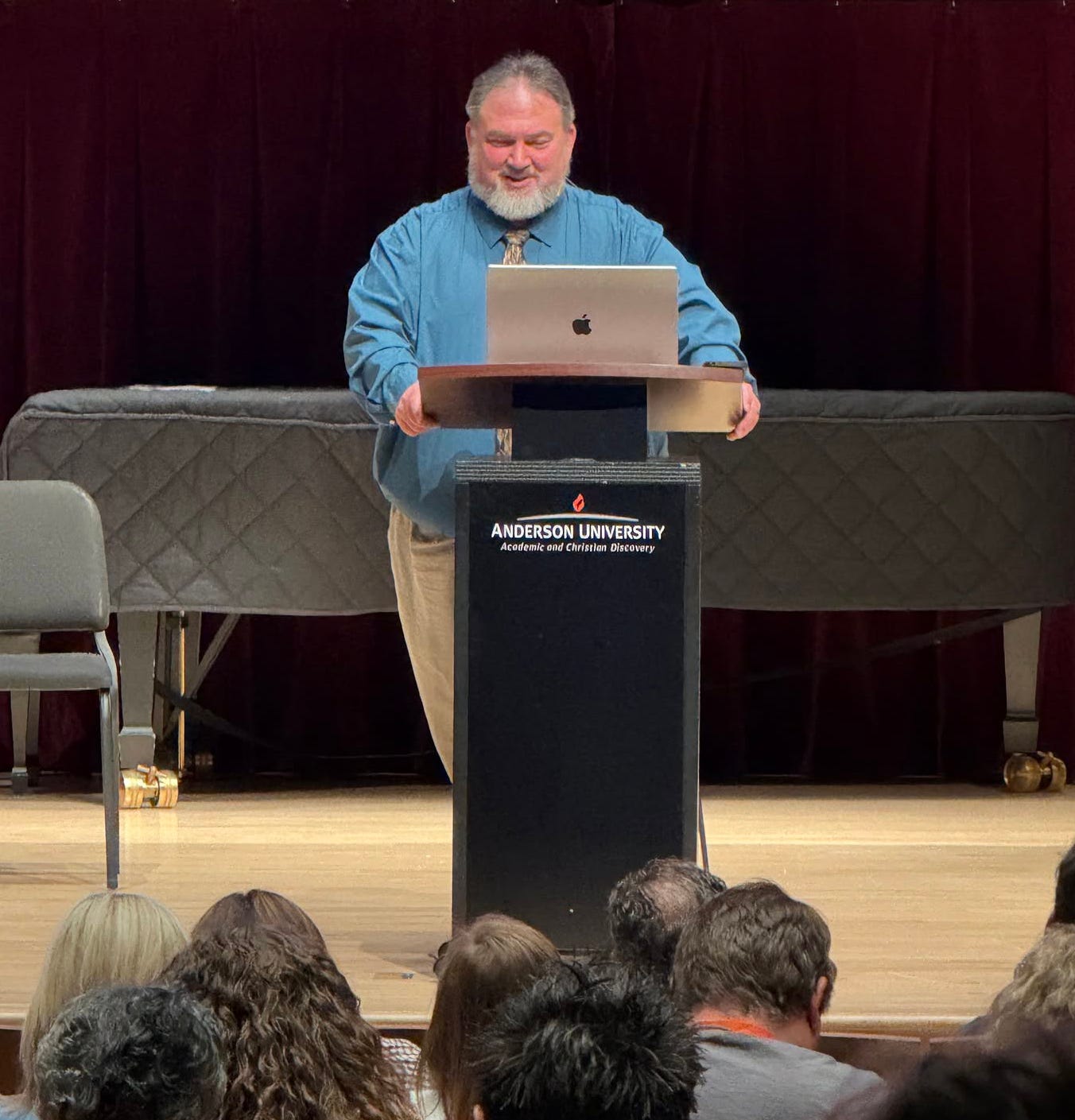
Developing that workshop took weeks of prayerful research and preparation, days of thinking, praying, and writing, along with a good deal of ideative collaboration with my favorite AI tools (I wanted to practice what I preach). The framework I am about to share with you is the very one I used to prepare my talk, as well as one of the key takeaways I shared in it.
The Arguments Always Sound Familiar
I did not have to reconstruct those objections from history books. I recognized them on sight. Why? Because across more than two decades of working bivocationally in technology innovation roles, I have watched that same script play out in both contexts. It sounds one way in a university faculty meeting when someone proposes a new learning platform, and another way in a church board meeting when someone suggests a livestream camera in the sanctuary. But underneath, it is the same handful of concerns, lobbed against essentially the same desires for innovation and outreach.
And the lineage is long. The church raised versions of these very objections against the printing press, against the microphone, against the overhead projector. Faithful leaders pressed through every one of them, and the mission was better for it. That is the pattern I wanted to name out loud before we turned our attention to the newest tool on the list.
The Real Question Was Never “Whether”
What encouraged me most was not the framework I brought. It was where I found the room already standing in agreement.
Going into my preparation, my rough estimate was that maybe ten to fifteen percent of the room would be deeply skeptical and resistant to AI altogether, and likely another ten to fifteen percent would be eager adopters already using it, and I figured that the broad middle (perhaps seventy to eighty percent), would be somewhere in between. As best I can tell, those numbers held fairly close to accurate. But the range of receptivity was not the surprising part (I’m used to that). The surprising part was where the two ends met…an intriguing convergence.
Even among the resistant, I sensed a quiet agreement that the need was real, and that the live question was not whether to use AI but how and when. And even among the eager adopters, when I shared my cautions, when I talked about how not to use it, when not to use it, and how to recognize when you have become too reliant on it, I saw the same nodding. Both ends of the room, the skeptics and the enthusiasts, had arrived at the same place. The debate was no longer for-or-against. The debate had moved to a better question: what does faithful, responsible use actually look like? I found that tremendously encouraging.
That convergence is the most important thing I can tell you about where this conversation is landing in churches right now. And, fortunately, it is not just my read of one room, either. Recent research from Barna, in partnership with Gloo, found that Christians are extending trust and registering fear about AI in the same breath, holding openness and concern together rather than resolving them. The tension I felt in that room is the same tension the data is measuring across the country.
And this is not only happening in the church. A national study from the National Bureau of Economic Research found that personal use of ChatGPT has overtaken work use, climbing from 53 percent to more than 70 percent of all messages. The everyday questions we once brought to a friend, a mentor, or a pastor are increasingly going to AI first (and OpenAI’s “Signals” data validates these trends, too, with a growing concern about the need to strengthen how it handles mental health conversations).
There is a reason that tension matters so much, and it raises the stakes for everything that follows. The people in our pews are not waiting for us to make up our minds. Barna found that a meaningful share of Christians are already prepared to treat AI as a spiritual voice, and that the willingness climbs sharply among younger adults. Our congregations are forming a relationship with this technology whether we guide them or not. Which means the preacher who learns to use AI rightly is not only protecting their own study. They are modeling, for people already drifting toward AI as an authority, what a healthy relationship to the tool actually looks like.
The Conscientious Objectors
I do want to be fair to the resistance I did encounter, because it deserves respect, not dismissal.
At the end of my session, one participant raised her hand with a genuine concern: can we really embrace a technology that consumes so much water and carries an environmental cost? I told her, honestly, that I could talk for another half hour on that single question alone, and I pointed her to the fuller treatment I have already written on the subject.
I share that exchange because it points to something every minister and every educator needs to understand. There are people in our churches and our classrooms whom I have come to call “conscientious objectors” to AI. They are not Luddites. They are not afraid of technology. They hesitate because they believe, on principle, that it does harm, whether to the environment, to workers whose jobs are displaced, or to something they cannot quite name. That conviction is worthy of a pastor’s respect.
But here is what I have also learned: a great deal of the concern and hostility surrounding AI rests on misinformation, on misperceptions, or on metrics that are genuinely difficult to quantify and reconcile. That does not make the concerns illegitimate. It makes them a reason to ask better questions rather than to settle for easy verdicts. I have written about both the environmental impact and the question of AI and jobs elsewhere, and I would commend those pieces to you if these are the questions keeping you, or your people, on the sidelines:
Asking Better Questions about the Environmental Impact of Technology - How to lead faithfully when technology debates become local
AI Is Coming for Jobs. Now What? - What the data actually says — and why it matters for your congregation
After, Not Instead Of
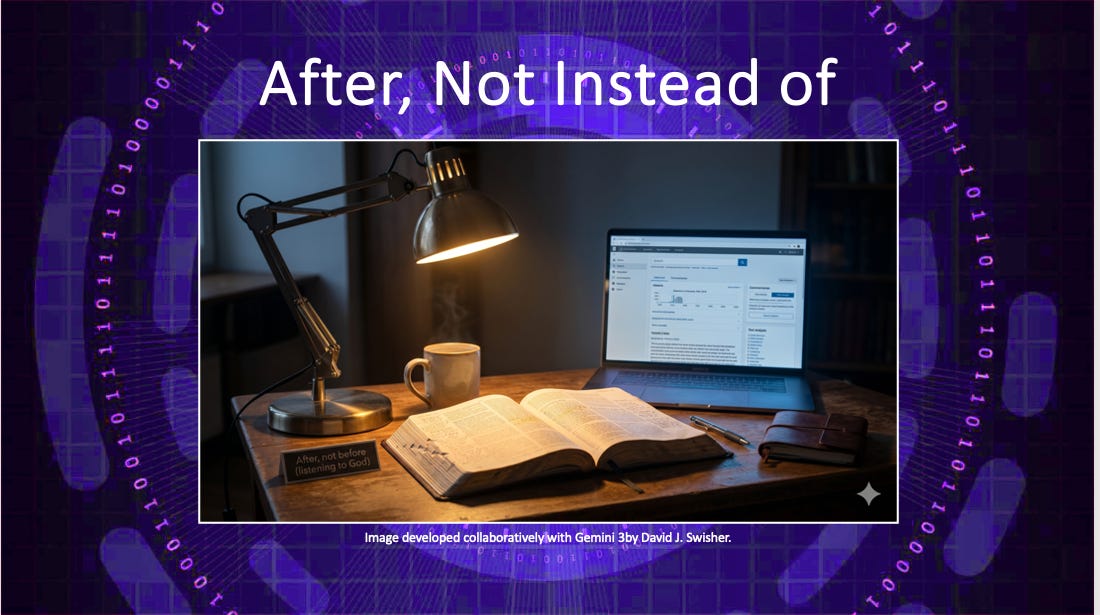
So if the question is not whether but how and when, let me give you the most useful thing I shared in that room. It is a simple framework, and I offer it not as a rule but as a tool for your own discernment.
Think about your sermon preparation in three phases.
The first phase is listening. This is the front end of everything. Prayer. Reading the text slowly, in more than one translation if that is your practice. Sitting with the passage. Asking the Spirit to illuminate it. Letting your own pastoral context, the faces of your people, the burdens you have been carrying all week, come into contact with the text before anyone else’s framework does. Noticing what troubles you, what you do not understand, what you are drawn to, what you are resisting. This phase belongs to you and the Spirit. AI does not enter here.
The second phase is study. This is where you do the exegetical and interpretive work: original language study, commentary research, historical and cultural background, cross-references, theological reflection. This is where AI can be a genuinely useful research partner. Not the first voice in the room, but a capable assistant. Help me understand the major interpretive positions on this passage. What is the cultural background of this practice in first-century Judaism? What do Wesleyan commentators emphasize here? Those are legitimate, valuable uses.
The third phase is development. This is where the sermon takes shape: structure, illustrations, language, application. AI can help here, too. Not to generate the sermon for you, but to pressure-test your argument, to brainstorm illustration possibilities, to surface assumptions you are making about your congregation that may not hold.
The key principle is sequence. AI enters the process after you have listened, not instead of listening. After the Spirit has had first access to the preacher and the passage, not before. This is not about limiting AI. It is about protecting something irreplaceable.
And here is why that first phase cannot be skipped. There is a kind of preparation where you survey the passage, gather the information, identify the main point, and build a structurally sound message. It is efficient. It is organized. AI is extraordinarily good at it. And then there is another kind of preparation, where you sit with a passage long enough that it begins to trouble you, where the comfortable reading breaks down and you have to stay in the discomfort until something new emerges. The preacher who has been through the second kind of preparation carries something into the pulpit that the first kind cannot supply. And the congregation can feel the difference, even when they cannot name it.
AI cannot do the second kind. It cannot be troubled by a passage. It cannot wrestle, because wrestling requires something at stake, and AI has nothing at stake.
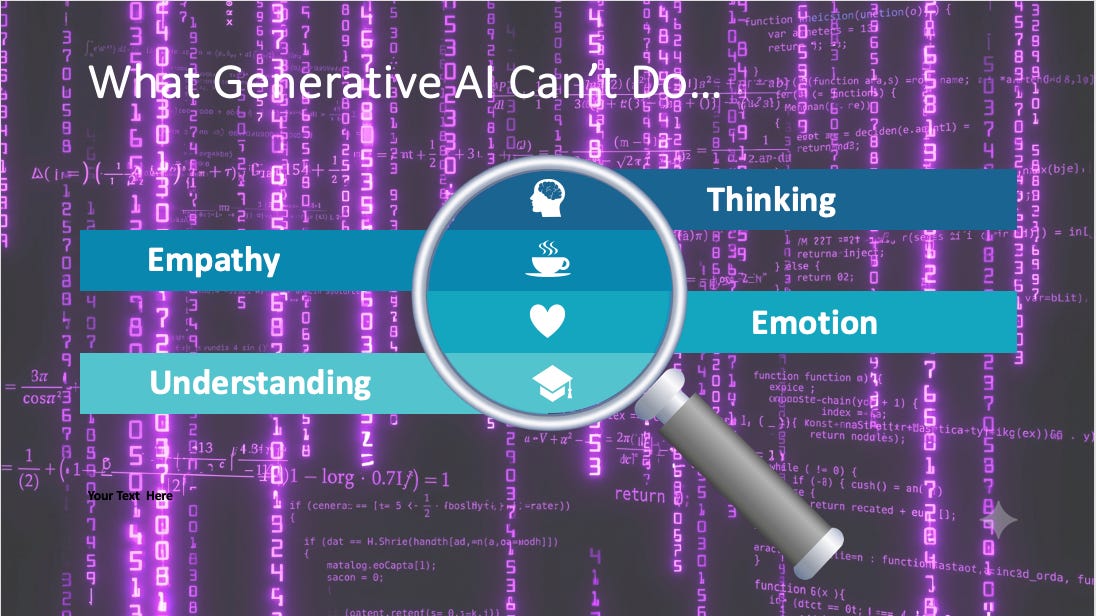
And this is not a knock on the technology. It is simply what the technology is. For all its fluency, generative AI cannot truly think, it has no empathy, it does not feel emotion, and it has no real understanding of the words it produces. It is making a remarkably sophisticated prediction about what word should come next, drawn from patterns in an enormous dataset. That is genuinely useful for the second kind of preparation. It is no substitute at all for the first.
The risk was never that AI would produce bad sermons. The risk is that it would produce sermons that were never wrestled with.
Not Just for Preachers, but for ALL Communicators
Now, I know not everyone reading this steps into a pulpit on Sunday morning. τέκτων has always been about the intersection of technology, innovation, and ministry, and that ministry takes a wide variety of forms.
So let me widen the frame without losing the point. The same sequence that protects the preacher protects the Christian educator preparing a lesson, the small group leader building a study, the worship leader planning a service, the communications director shaping a church’s message. You may never preach a sermon, but you are still doing the work of listening for what God is saying and then giving it form. And you face the same temptation the preacher faces: to let AI frame the encounter before you have done your own listening, and in doing so, to hand away the most valuable part of the work. The discipline is the same. Listen first. Bring AI in after.
Finding the Right Balance
How do you know if you have the balance right? In the workshop, I offered two short lists, and I will offer them to you here as a self-check.
There are signs you may not be using AI enough:
Your research method has not changed in ten years. I still treasure my Strong’s Concordance, a gift from my parents for my seventeenth birthday, shortly after I was called to ministry and licensed to preach. But I rarely reach for the bound copy anymore, and that is not a betrayal of it. It’s deeply integrated into other digital tools I use now, like BibleHub’s Interlinear, Logos, and BlueLetterBible.
You are not getting honest feedback. Most pastors are surrounded by people who love them and do not want to hurt their feelings. You won’t get honest feedback unless you explicitly ask for it, and push for it. An AI tool may initially be sycophantic, but if you tell it you want an honest critique, and you want tips for improvement or clarity, it will. It is not afraid to tell you the third illustration in a row assumed a two-parent household.
You have decided AI is a threat without ever giving it a try. That is not discernment. That is merely avoidance, and it’s dishonest. The staunchest opponents of AI in ministry are those who have never actually used it or tried working with it. Once you do, it changes your approach from avoidance to discerning how to use it appropriately and effectively.
And there are signs you may be over-relying on AI:
You reach for the AI before you spend meaningful time in prayer and silence. That is not a technology problem. It is a spiritual formation problem that the technology has merely exposed. AI has a place, but it’s definitely NOT the first place to turn.
The sermon is starting to sound more like the AI than like you. Over time, the trend becomes hard to miss. Having it help you explore possibilities, consider nuances, draft outlines, come up with effective illustrations, etc., can be good, but if it’s just generating content for you and you’re not driving 90% of the thinking process, it will quickly show.
You cannot reconstruct your own argument without consulting the draft it helped you generate. We see this in education circles, and it’s a clear sign that the AI did the work, not the user. When you are in the driver’s seat, you know what you are going to say and why, and you’re using the AI to hone and perfect your presentation and conclusions.
Hold those two lists side by side, and one question rises to the surface. It is the question I left that room with, and I leave it with you:
Is the way I am using AI, or not using it, making me a more faithful, Spirit-attentive, pastorally present preacher? Or less of one?

The Amplifier
Years ago, in some of the small rural Midwest churches I served, there was an old tradition of a receiving line. People would file past on their way out the door and offer the customary “Nice message, pastor.” It was kind and cordial, but as an introvert, I hated it; it always felt so inauthentic. And more often than I would like to admit, I wondered whether the person giving that compliment had actually heard a word I said, or whether they would be doing anything different on Monday as a result.
But this room was not like that.
When they invited me to lunch and then to a book table to sign copies and answer questions, I got to talk with the participants one by one.
I asked nearly everyone similar questions:
What did you find most helpful?
What was your biggest takeaway?
What resonated most with you?
And every single person had an immediate, specific answer. There was no polite vagueness. They were interested, eager, open, and engaged. They wanted to know where the guardrails are, what works and what does not, and how to use this well. I found that deeply encouraging, and I think it bodes well for the future ministry of the Church.
Because in the end, that is what AI is. It is an amplifier. It amplifies what you bring to it: your voice, your perspective, your pastoral context, and the Spirit’s insight and urgency. It cannot supply what you do not bring. The sermon that changes a life this Sunday will come from a preacher who has prayed, wrestled, listened, and shown up. AI can absolutely help you prepare better, and more efficiently.
But it cannot preach for you. And quite frankly, it shouldn’t.
The Spirit still speaks. Our task is to make sure we are still listening, first.
If these are the questions you are wrestling with, I would welcome you as a subscriber to τέκτων (tektōn). It’s all about the intersection of technology, innovation, and ministry, with a special emphasis on responsible use of generative AI.
Resources referenced in this article:
Barna Group, in partnership with Gloo. “AI Is Becoming a Spiritual Authority, Even Among Practicing Christians.” Barna. May 19, 2026. Accessed June 7, 2026. https://www.barna.com/research/christians-trust-ai-flourishing-spiritual-authority/.
Chatterji, Aaron, Thomas Cunningham, David J. Deming, Zoe Hitzig, Christopher Ong, Carl Yan Shan, and Kevin Wadman. “How People Use ChatGPT.” NBER Working Paper 34255. National Bureau of Economic Research, September 2025. https://doi.org/10.3386/w34255.
OpenAI. “Signals Consumer Data.” OpenAI. May 11, 2026. Accessed June 8, 2026. https://openai.com/signals/data/.
Swisher, David J. “Redeemed for Those Not Yet a Part.” τέκτων (tektōn). May 11, 2026. https://tektonministry.substack.com/p/redeemed-for-those-not-yet-a-part
—. “Asking Better Questions about the Environmental Impact of Technology.” τέκτων (tektōn). April 27, 2026. https://tektonministry.substack.com/p/asking-better-questions-about-the
—. “AI Is Coming for Jobs. Now What?” τέκτων (tektōn). April 13, 2026. https://tektonministry.substack.com/p/ai-is-coming-for-jobs-now-what
—. Early Warning: How to Lead with Wisdom in Times of Technological Disruption. Invite Press, 2025.